---
title: How Summer Heat Damages Commercial Roofs in Texas (And How to Prevent It)
description: Extreme Texas summer heat can turn minor commercial roof vulnerabilities into costly failures. Learn how to protect your asset with proactive maintenance.
image: https://www.chamberlinltd.com/hubfs/Site_Images/Roofing-sheet-metal-services-1.jpg
---
[
Client Login
](https://www.chamberlinltd.com/articles/log-in-to-your-account)
[
877-428-1000
](tel:8774281000)
[
Report a Leak
](https://www.chamberlinltd.com/report-a-leak)
[ ](https://www.chamberlinltd.com)
# How Summer Heat Damages Commercial Roofs in Texas (And How to Prevent It)
Posted on: June 23, 2026 4 PM
### 
Texas summers are legendary for their unforgiving intensity. While property owners easily recognize the strain that consecutive triple-digit days place on HVAC systems and electrical grids, a building's first line of defense often bears the heaviest burden in silence.
Commercial roofs in Texas are constantly exposed to solar radiation, soaring ambient temperatures, and sudden atmospheric shifts. Without proactive intervention, the extreme climate can rapidly accelerate the aging process of commercial roofing systems, turning minor vulnerabilities into catastrophic, costly failures. Understanding the specific mechanisms of heat damage is the first step toward safeguarding your investment.
### **The Physics of Thermal Shock and Rapid Expansion**
One of the most destructive forces acting on a commercial roof during a Texas summer is the physical phenomenon known as thermal shock. This is not merely a function of high temperatures, but rather the speed and frequency of temperature fluctuations.
##### **Understanding the Day-Night Temperature Cycle**
During a typical July or August day in cities like Houston or Dallas, ambient temperatures frequently exceed 100°F. However, due to solar absorption, the actual surface temperature of a dark commercial roof can skyrocket to anywhere between 150°F and 180°F. At these extreme temperatures, industrial roofing materials whether modified bitumen, TPO, PVC, or EPDM physically expand to accommodate the heat.
When the sun sets, or when a sudden afternoon thunderstorm rolls through, the surface temperature can plummet by 50 degrees or more in a matter of minutes. This triggers a rapid, violent contraction of the entire roofing assembly.
##### **The Structural Toll of Material Fatigue**
This constant tug-of-war between expansion and contraction places immense physical stress on the system. Over time, the materials experience structural fatigue. The consequences of this ongoing movement manifest in several ways:
- **Seam Separation:** The adhesive or welds holding the roof membrane sheets together begin to pull apart, creating direct pathways for water intrusion.
- **Flashing Failure:** Roof flashings, the metal pieces installed around perimeters, valleys, and penetrations like pipes and vents expand and contract at different rates than the roof membrane itself. This discrepancy causes the seals around critical areas to crack and pull away.
### **UV Degradation: The Silent Molecular Accelerator**
While temperature dictates the physical movement of a roof, ultraviolet (UV) radiation alters its chemical makeup. The sun emits powerful UV rays that relentlessly bombard roofing surfaces all summer long.
Roofing membranes are engineered with specific chemical compounds designed to keep them flexible, durable, and waterproof. Extended, high-intensity UV exposure can break down these molecular bonds over time. As the essential oils, plasticizers, stabilizers, or other protective compounds within the roof system age, the membrane can gradually lose flexibility and become more brittle.
Once a membrane loses flexibility, it becomes more susceptible to cracking under roof traffic, building movement, thermal cycling, and standard building settling.
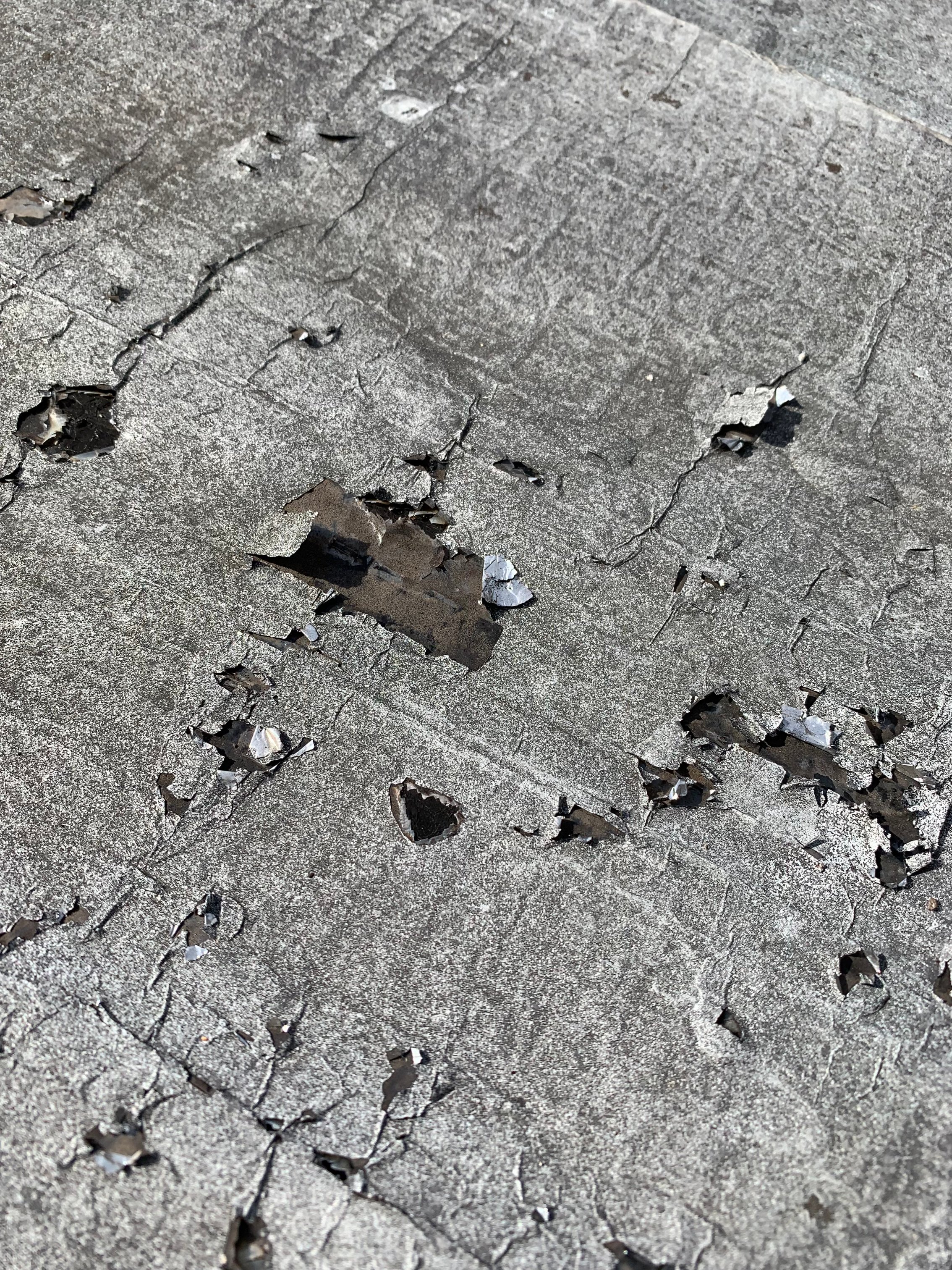
The visible effects of UV degradation can vary depending on the type of roof system. In built-up roofs (BUR) or modified bitumen systems, UV degradation can accelerate the loss of protective surface granules and oxidation of the asphalt-based surface. Once these granules are worn away or displaced, the underlying asphalt matrix becomes more directly exposed to the sun, which can lead to surface checking, cracking, and in severe cases, alligator cracking or alligatoring across the roof surface.
Single-ply membranes such as TPO, PVC, and KEE are formulated with UV-resistant compounds, but prolonged exposure to Texas heat, UV radiation, ponding water, chemicals, or heavy foot traffic can still contribute to surface erosion, discoloration, crazing, embrittlement, or reduced flexibility over time.
Routine roof inspections can help identify these early signs of UV-related aging before they develop into open cracks, membrane splits, leaks, or larger roof system failures.
### **Trapped Moisture and Sub-Roof Vaporization**
In many regions of Texas, summer heat does not arrive in a vacuum; it is accompanied by intense humidity and sudden tropical downpours. This combination creates a volatile environment for any commercial roof that already harbors minor, undetected leaks.
When rain falls on a compromised roof, water can seep through tiny cracks and become trapped within the insulation layers beneath the upper membrane. When the storm clears and the intense Texas sun returns, the roof surface heats back up to extreme temperatures.
This trapped liquid water quickly heats up and undergoes vaporization, expanding significantly as it turns into steam. Because the waterproof top membrane acts as a barrier, the steam cannot escape. Instead, it forces its way upward, creating large pockets or "blisters" in the roof membrane.
As these blisters expand, they stretch the roofing material to its breaking point, making it highly susceptible to puncturing. Furthermore, the trapped moisture causes dark, humid conditions underneath the surface. This rapidly destroys the thermal efficiency (R-value) of your insulation and creates a breeding ground for mold, wood rot, or deck corrosion.
### **Key Signs Your Roof is Suffering from Heat Damage**
Catching heat damage early can mean the difference between a simple patch repair and a premature, multi-million-dollar roof replacement. Property managers should look out for these definitive warning signs:
##### **A Checklist for Property Managers**
- **Cracked or Brittle Membranes:** Visually inspecting the roof may reveal a fractured surface, fine hairline cracks, or an "alligator hide" texture on asphaltic roofs.
- **Splitting and Open Seams:** Look closely at the areas where membrane sheets overlap. If the edges are curling, lifting, or separating, the structural integrity is compromised.
- **Loose Flashing and Cracked Sealants:** Inspect the base of HVAC units, parapet walls, and plumbing vents. Cracked caulking or gapping metal pieces indicate severe thermal movement.
- **Bubbling and Blistering:** Pockets of raised membrane indicate trapped air or expanding water vapor underneath the surface.
- **Accelerated Indoor Cooling Costs:** If your energy bills are climbing unexpectedly, it could indicate that your roofing insulation has degraded or that the roof surface is absorbing too much heat, forcing your HVAC units to work double-time.
- **Interior Water Stains:** Yellow, brown, or bubbling spots on ceiling tiles after a summer storm are a clear indicator that heat-induced cracks have already allowed water to penetrate the building envelope.
### **Proactive Prevention & Mitigating Strategies**
You cannot change the Texas weather, but you can change how your facility responds to it. Implementing a strategic, proactive maintenance plan can extend the lifespan of your commercial roof by a decade or more.
**Schedule Bi-Annual Professional Inspections: **The most effective way to combat heat damage is to identify vulnerabilities before the peak of summer hits. A professional commercial roof inspection should be conducted every spring and fall. Technicians can perform infrared moisture scans to detect sub-roof vaporization before visible blisters form, secure loose flashings, and reinforce weakening seams.
**Invest in Highly Reflective Cool Roof Coatings: **For existing roofs that are structurally sound but vulnerable to heat absorption, applying a high-performance reflective elastomeric coating is a highly cost-effective upgrade. These bright white coatings are designed to reflect up to 85% of solar radiation back into the atmosphere. By dropping the surface temperature of the roof closer to ambient levels, you drastically minimize thermal shock, preserve the elasticity of the underlying membrane, and significantly lower the cooling load on your building’s HVAC systems.
### **Contact Our Offices **
The intense summer climate in Texas poses a continuous threat to commercial roofing systems. Through the combined forces of thermal shock, UV molecular degradation, and moisture vaporization, unchecked heat can quietly dismantle a building's primary line of defense. However, through diligent monitoring, timely repairs, and modern preventative solutions like reflective cool roof coatings, you can successfully mitigate these risks.
Do not wait for an interior ceiling leak or a catastrophic system failure to tell you that your asset is in trouble. If you notice any signs of blistering, cracking, or rising energy costs, it is time to take action. [Contact](https://www.chamberlinltd.com/contact-us) our team today to schedule a comprehensive, professional commercial roof assessment.
#### Subscribe Today!
Stay-in-the-know and subscribe to our blog today!
## Related Articles
[### Cold Weather Impacts on Commercial Roofing Systems in Texas: Insights from Chamberlin Roofing and Waterproofing
Posted on: June 23, 2026 4 PM
Cold weather can wreak havoc on commercial roofing and waterproofing systems, even in regions like Texas where winters are typically mild. Property and facility managers often overlook the risks...
](https://www.chamberlinltd.com/blog/cold-weather-impacts-on-commercial-roofing-systems)
[### The Most Common Causes of Commercial Roof Leaks
Posted on: June 23, 2026 4 PM
Commercial roof leaks can lead to costly damage if they’re not identified and repaired quickly. Even a small leak can compromise insulation, ceilings, walls, electrical systems, and valuable...
](https://www.chamberlinltd.com/blog/most-common-causes-of-commercial-roof-leaks)
[### Supporting Houston’s Commercial Buildings Through Partnership with BOMA Houston
Posted on: June 23, 2026 4 PM
](https://www.chamberlinltd.com/blog/supporting-houstons-commercial-buildings-through-partnership-with-boma-houston)
© 2026 | Chamberlin, Ltd.